

What is static electricity and what is the difference from "normal electricity"?
Electricity is a series of phenomena connected to the flow of electric charges, especially electrons.
The "type" of electricity which powers motors and many other devices, can travel in power lines or in small wires around the home is what is usually classified as "Normal" electricity.
However there is another "type" which is known as static electricity. They are both electricity, because they are about the same thing: movements of electrons.
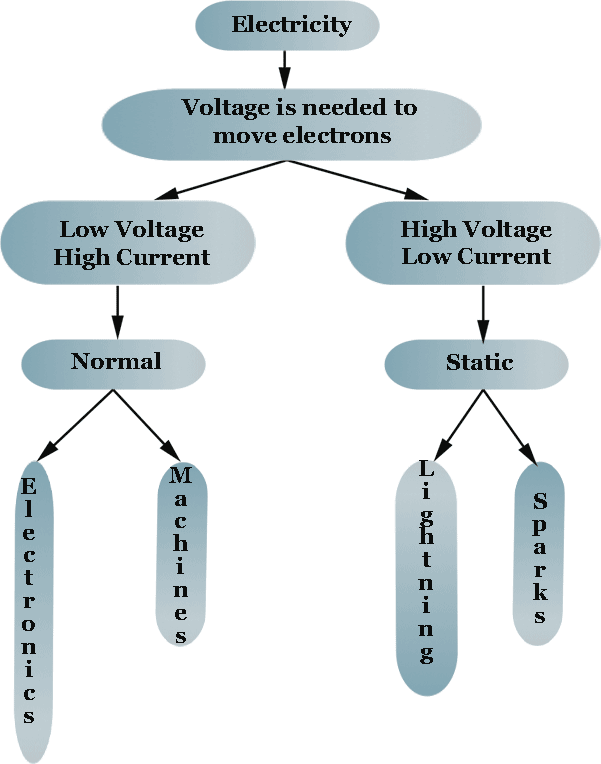
Concept map illustrating the relationship between static and "normal" electricity
A lightning stroke is an example of a process involving "Static electricity". That is because there is a build up of electrical charge (electrons) in the clouds. Actually static electricity is not a very good name for this "type" of electricity because static means not moving, and lightning is a very dynamical event . The charges eventually move between the skies and the earth's crust , what is a very exciting journey
How charges accumulate in a cloud to create a high voltage?
The build up of charges in the cloud, which causes lightning, is caused by the movement of air which is rising from the bottom of the cloud to the top. As a result of this friction (air-cloud) electrons from air are deposited in the cloud, which can become highly charged . This excess of charge is liberated towards the ground or a neighbouring cloud, which is not negatively charged to that extent. This is lightning.
Static means not moving. However, electricity is very often moving and that is one of the reason why it can be so useful. In conclusion, static electricity is not a very good name for this "type" of electricity, A more appropriate way to distinguish between these two aspects of electricity is that:
Static electricity
Involves very high voltages and very low currents.
Doesn't usually travel inside wires.
"Normal" electricity
Involves much lower voltages and much higher currents
Usually travels inside wires
The numbers
Static electricity involves very high and very low numbers, so that calculations would be a bit complicate. So, there is no calculations on that! (luck you!)
However you need to know some facts and also about the electroscope, which is an instrument that measures this sort of electricity.
Calculations are done on normal electricity, where easy numbers are used. For instance 5 V, 240 V , 5 A, etc...
Ohm's law will solve almost all your exercises in this area.