






Kinematics
It is the study of motion. Kinos (from Greek) means movement. The word cinema comes from kinema (moving images). Kino means cinema in German.
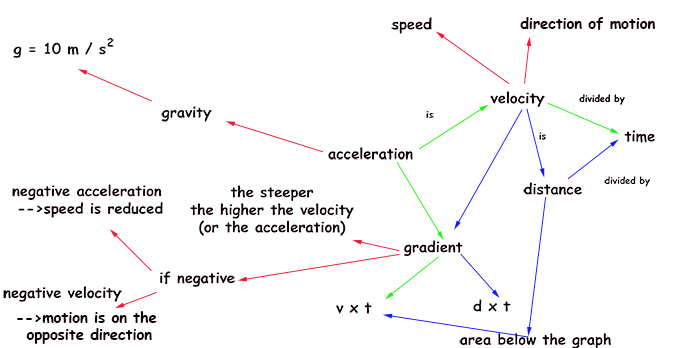
Concept map on kinematics concepts
The map above summarises various ideas about motion. Some will be explained to make sure it is all understood:
1) Velocity is different from speed. That is because velocity also includes the direction of movement: it is a vector and not only a number as speed is.
2) When an acceleration (a) is present, the velocity changes accordingly (formulae on the left side of the page). When the velocity is positive, the velocity increases if the acceleration is also positive ; if the acceleration is negative the velocity decreases (braking). Positive velocity usually menas that the motios in directed to the right and negative velocity is the motion on the opposite direction, that is, to the left.
3)The gradient of the graph is its inclination. It is calculated as the tangent of the angle between the x axis and the actual graph. The gradient of the d x t graph is the velocity and the gradient of the v x t graph is the acceleration.
4) The distance travelled can be calculated as the area under the graph v x t.
The units for acceleration are meters per second squared (m / s2). This is the unit for velocity (m / s)divided per time (s).
If there is no acceleration the velocity is constant. This simple case is discussed here>>
What formula to use?
 vf = final velocity (m/s)
vo= initial velocity
t = time (s)
a = acceleration (m / s2)
sf = final position
so= initial position
Formula III is called Torricelli's equation.
Instead of using formulas, the problems can also be solved using graphs>>
Examples and solved problems (using the formulas above):
1) The acceleration of a car is 5 m / s2 . If it is initially at rest, what will be its speed after 20 s?
Use formula (I):
vo = 0 (initial speed)
v = at= 5*20 = 100 m/s
2) A car , initially travelling at 10 m/s, develops an acceleration of 6 m/s2 during 5 s. How far does it travel during this 5 s?
Use formula (II):
vo=10m/s
a= 6m/s/s
sf - so= distance travelled= 10*5+ 6* 5*5 / 2 = 125 m
3) Car A leaves from rest (vo=0) , 10 miles down the road . It has an acceleration of 2 m/s2.
Car B leaves from the beginning of the road (so=0) and its initial speed is 10 m /s. Its acceleration is 5 m/s2.
How long will take to car B to meet car A? At what position the meeting will take place?
(Two cars travelling on the same road with different accelerations)
Use formula (II):
When the 2 cars meet, their position s must be the same. Firstly, let's write the expression for s in both cases:
car A: sf = 16000 + 2*t2/2
car B: sf = 10t+5*t2/2
Putting these 2 equations together we have an equation that can be solved to obtain t:
16000 + 2*t2/2 = 10t+5*t22
-3*t*t-10t+16000=0
3*t2+10t-16000=0
You just have to solve this second degree equation to get t. After that, you can plug t in any of the expressions for s (car A or B) in order to obtain the position where they meet.
4) An airport runaway has a length of 2 km. Considering that an airplane lands at one end of the runaway and manages to brake and come to rest at the other end, what is the maximum speed the plane can land at? Consider that the brakes provide an acceleration of -5 m/s2.
Comment: on this problem we have a distance , an acceleration and a final speed, so that we must use formula III.
© Ricardo Esplugas. All images in this site can be bought in an enlarged version. Please contact me on [email protected]